
QR-code tool tracking 2026 – how a digital tool management system works
A modern tool management system replaces spreadsheets, binders and "gut feeling" with digital workflows. This is the complete guide to how QR labels, tracking, service, calibration management and AI reports work together – and how a tool system connects to Smart 5S and lean for maximum effect on the workshop floor.
What is a tool management system?
A tool management system is a digital platform that consolidates all information about an organisation's tools, machinery and equipment in one place. The goal is to know what you own, where it is, who is responsible for it and what condition it is in – in real time.
In practice this means each tool is labelled with a unique identifier (usually a QR code), registered in the system with metadata (type, model, owner, location, service interval) and then tracked throughout its entire lifecycle: from purchase, through use and maintenance, to disposal.
Typical components
- Digital register – database with all tools and their attributes.
- Identification – QR codes, barcodes or RFID on every item.
- Scanning – mobile-based interface for logging usage and faults.
- Service and calibration management – automated notifications and history.
- Reports & analytics – insights on costs, usage and procurement needs.
Benefits – why digitalise tool management?
Companies that switch from manual handling to a digital tool system report clear effects across multiple areas. Here are the most common gains.
Cost savings
- Less waste – tools are lost less often when ownership is clear.
- Longer lifespan – the right service at the right time prevents costly breakdowns.
- Smarter purchasing – data shows which models actually pay off.
- Fewer duplicate purchases – when the fleet is visible, fewer unnecessary tools are bought.
Safety and quality
- Up-to-date calibration – measuring instruments in use are always valid.
- Documented traceability – important for ISO audits and warranty claims.
- Fast fault reporting – damaged tools are taken out of service before accidents occur.
Time and efficiency
- Less searching time – everyone knows where the tool is, instantly.
- Administrative hours disappear – inventory happens automatically.
- Faster onboarding – new staff find the right tools from day one.
Practical effect
Our customers typically report 10–25 % lower tool costs in the first year as well as a marked reduction in inventory and search time. The effect is greatest when the tool system is combined with 5S methodology.
How Delatool's tool system works
Delatool is built from the ground up for industrial and construction businesses. The whole workflow is organised around four simple steps: scan, track, service and analyse.
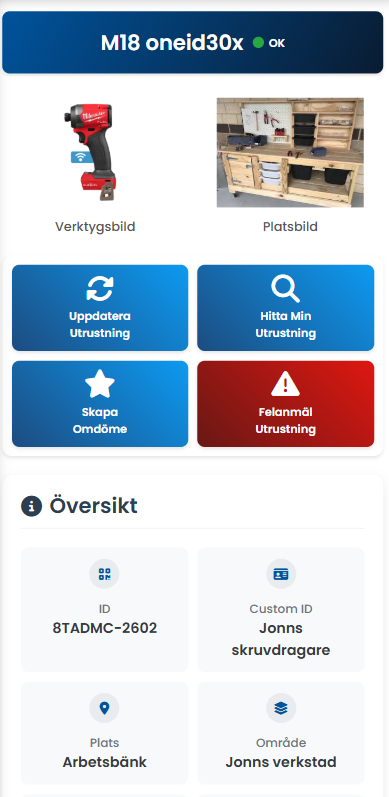
1. QR labels and scanning
Each tool gets its own QR label. Scanning happens directly in the mobile camera – no app or sign-in is required for basic interaction. This means anyone on the worksite can see the tool's status, report a fault or read the user manual without friction.
2. Tracking, ownership and history
Each scan logs where, when and by whom the tool was handled. The system automatically builds a history per tool – usage, movements, repairs, claims and disposal. Ownership can sit with a person, team, vehicle or site.
3. Multi-site positioning
Organisations with multiple sites are handled in the same account. Permissions, reports and workflows can be separated per location – while the group gets a consolidated view of the entire fleet. Perfect for contracting groups, property portfolios and multi-site industry.
Service, calibration and inspection – automated
One of the most common reasons companies switch to a digital tool system is precisely service and calibration management. Manual lists always miss deadlines – digital notifications do not.
How it works in Delatool
- For each tool you set intervals for service, calibration and inspection.
- The system sends a notification in good time to the responsible person.
- Completed actions are registered with date, signature and any certificates.
- The full history is searchable and exportable for audits.
Why this is critical
For ISO audits, health-and-safety inspections or insurance claims it is the documentation that counts. A tool system with digital traceability means you can always prove that the right action was performed at the right time – without searching through binders or inboxes.
AI reports and procurement support
Delatool uses AI to analyse data across the entire tool fleet – not to replace your buyers, but to give them better decision support.
What the AI does
- Identifies underperforming tools – models that break often or are rarely used.
- Analyses repair patterns – warns when a tool has become uneconomical to service.
- Suggests purchases – based on historical use and wear.
- Compares reviews – aggregates user feedback per model.
The AI reports also integrate with our Deep Search feature to compare prices and specifications against external databases. This gives you an objective view of what the tool you are considering actually costs – and whether better alternatives exist.
Integrations and scalability
A tool system is rarely an isolated island. Delatool supports API integrations with the systems you already use – so tool data can flow to finance, HR, procurement and field equipment.
Typical integrations
- Finance systems – activation, depreciation and cost allocation per project.
- ERP / Procurement – automated purchasing suggestions and supplier data.
- HR and permissions – employees are automatically linked to tools and access rights.
- Project systems – tool usage allocated per project for accurate billing.
Scalability
Delatool is built to scale from a small workshop with 50 tools to an industrial group with tens of thousands of items across multiple countries. You start where you are – and grow at the pace that suits your business.
Connection to 5S and lean
A tool system and the 5S methodology are both answers to the same question: How do we create order, tidiness and flow in the workshop? They complement each other perfectly.
Tool system without 5S
You get full digital control of the tools, but the work environment itself – where things should be, how the spaces look, how standards are followed – is left manual. It works, but much of the visual control that 5S provides is missing.
5S without a tool system
You get a well-organised physical workplace, but you lack digital traceability for tool condition, service and ownership. The first time a tool goes missing, follow-up becomes difficult.
Tool system + 5S (Complete)
When you combine both, you get the complete digital workplace. QR labels on tools are linked to signs on 5S areas. The Set-in-Order step of 5S becomes data-driven instead of subjective. Audits, standards and tool service operate in the same platform.
The lean principle: eliminate muda
Lean talks about muda – waste. Searching for tools, double-buying, missing calibration or repairing broken equipment are all forms of muda. A tool system combined with 5S is the most effective anti-muda structure a modern workshop can have.
Implementation step by step
Introducing a tool management system can feel big – but it doesn't need to be. We recommend a pragmatic approach where you start small, learn quickly and scale in a controlled way.
Step 1 – Inventory
Go through your existing tool fleet. You don't need full insight from the start – a rough list is enough to get going. Delatool supports CSV import if you already have a spreadsheet.
Step 2 – Labelling
Print QR labels from Delatool and apply them to the tools. Start with the tools that disappear most often or are most valuable – this gives the fastest ROI.
Step 3 – Base data
Register metadata: owner, site, service interval, calibration date. You can add to this gradually – the system does not require everything to be ready on day one.
Step 4 – User testing
Let one team test the scanning workflow in a live environment. Gather feedback. Adjust metadata and processes. Then roll out to more teams.
Step 5 – Activate service and AI
Once base data is in place, service notifications and AI reports are activated. Now the system really starts paying back – every avoided calibration penalty is money saved.
Step 6 – Integrate and scale
Connect with finance systems, ERP and field systems. Add more sites. Consider combining with 5S if you haven't already.
Typical timeline
Most customers have a working tool system in production within 2–4 weeks of kick-off, and full effect with AI reports after 3–6 months when the data volume is enough for the analysis to be accurate.
Want to see how this would look at your organisation? Read more about Delatool's tool system, compare packages and pricing or start a free 30-day trial directly.
